
Materials
Best Bathroom Tile for Older Homes in Southeastern PA (2026 Buyer’s Guide)
The tile that actually performs in older Chester County, Delaware County, and Main Line bathrooms — cost, durability, and what fails.
Not ready for a call? Send us a quick question
Last updated: May 2026 · Alex Smearman, Fedor Fabrication
Key Takeaways
- Most reliable older-home combo: large-format porcelain (12×24+) floors, ceramic subway (3×6/4×12) shower walls, mosaic (1×1/2×2) shower pans. Installs over a self-leveled subfloor, lasts 30+ years.
- Installed cost 2026: $6–$12/sq ft standard porcelain, $10–$18 ceramic subway and mid-grade porcelain, $18–$35 natural stone and premium porcelain, $22–$60 zellige and handmade, $30–$90+ imported designer.
- Older homes (1988–2008) carry three constraints Pinterest skips: self-leveling adds $2–$4/sq ft, sistering joists runs $400–$1,200, and a Schluter Kerdi assembly adds $800–$1,500 per shower.
- Floor tile must hit DCOF ≥ 0.42 per ANSI A137.1; shower pans 0.60+. Polished porcelain and polished marble fail this on a floor.
- Avoid marble and travertine in wet areas. Both are porous and reseal every 12–18 months for life; marble etches from anything acidic.
Quick Answer
For most older homes (1988–2008 stock) across Chester County, Delaware County, and the Main Line, the best bathroom tile in 2026: large-format porcelain (12×24 or larger) on floors; ceramic subway (3×6 or 4×12) on shower walls; mosaic (1×1 or 2×2) on shower pans for the slip rating; handmade zellige or specialty only as an accent. Avoid travertine and natural marble in wet areas — they etch, stain, and reseal every 12–18 months for life.
Tile is the single biggest visual decision in a bathroom remodel, and the line item that swings the budget the most. The fear we hear: “I’m about to spec a $5,000–$15,000 tile package and I don’t know whether anyone is steering me toward what’s best for me or what’s best for them.”
The Five Materials
Five Tile Categories — Where Each Belongs
- Porcelain. Denser than ceramic, fired hotter (2,200°F+), water absorption below 0.5% — TCNA treats it as effectively waterproof. Most durable, lowest-maintenance. Our default for most floors and shower walls.
- Ceramic. Softer body, glazed face, 0.5–7% water absorption. Best home: shower walls — especially 3×6 or 4×12 subway — where labor is lower and the look never dates. Loses to porcelain on high-traffic floors.
- Natural stone (marble, granite, travertine, slate, limestone). Beautiful, irreplaceable visually, almost always the wrong call in a wet area unless you go in eyes open. Marble etches from anything acidic; travertine is porous; limestone stains; all of it reseals every 12–18 months for life.
- Glass. Almost always an accent — a stripe, a niche back, a feature inset. Substrate telegraphs through, so it has to be flawless. $25–$50/sq ft installed for small accents.
- Cement and handmade (zellige, encaustic, terracotta). The Pinterest darling of the last five years. Character machine-made tile can’t fake — but slow to set, expensive ($22–$60+/sq ft), most need sealing. Best use: one accent wall, vanity backsplash, powder room.
The lines we keep coming back to: TileBar and Roca for broad porcelain and ceramic field tile, Florida Tile for US-made porcelain with strong specs, Riad Tile for handmade zellige, Walker Zanger for the designer and natural-stone end. Each earned its place by performing in the warranty conversation a year later — not because a rep took us to dinner.
Older Homes
Why Older Homes (1988–2008) Have Specific Tile Constraints
Most of our service area is 18–38 years old: 1990s subdivisions in Downingtown and Exton, 1950s ranches and stone colonials in Wayne and Bryn Mawr. Three install realities decide what tile works and how it goes in.
1. Subfloor flatness. TCNA requires a substrate that varies no more than 1/8″ over 10 feet for tile up to 15″, 1/4″ over 10 feet for larger format. In a 30-year-old home where a tub or wax ring leaked for years, the subfloor never meets spec. We self-level before tile goes down. Adds $2–$4/sq ft. Skipping it is the most common reason large-format porcelain cracks within five years.
2. Joist deflection. TCNA requires no more than L/360 for ceramic and L/720 for natural stone. Plenty of 1990s homes here were framed with 2×10 joists at 16″ centers spanning 12–14 feet: fine for a bedroom, marginal for a bathroom carrying tile, mortar, and a cast-iron tub. Sistering a joist or adding blocking runs $400–$1,200 on top of the tile budget. On a recent West Chester remodel, the joists were sagging past what the homeowner’s selected tile would tolerate; they loved the tile, so we sistered, leveled, and installed the original selection. Ignoring it shows up as a hairline crack along a grout line within a year.
3. Waterproofing standards changed. Pre-2010, residential standard was tar paper or felt behind cement board — adequate for the era, not best practice now. Since 2010 the industry has standardized on sheet-membrane systems, with Schluter Kerdi dominant. We use Schluter on every shower. Membrane plus drain plus seam-banding adds $800–$1,500 per shower.
What Bathroom Tile Actually Costs Installed
2026 ranges across Chester County, Delaware County, and the Main Line. Includes material, setting labor, mortar/grout, and Schluter waterproofing where it applies. Does not include substrate prep or demo of existing tile — those are separate line items.
| Tile Category | Material $/sq ft | Installed $/sq ft | Best Application | Watch-Outs in Older Homes |
|---|---|---|---|---|
| Builder-grade porcelain (12×12, 12×24) | $3–$6 | $6–$12 | Floors, low-budget shower walls | Needs a self-leveled subfloor or it cracks |
| Mid-grade porcelain (large-format, wood-look, marble-look) | $6–$12 | $10–$18 | Floors, shower walls, niches | Large format magnifies any subfloor unevenness |
| Ceramic subway (3×6, 4×12 glazed) | $4–$10 | $10–$18 | Shower walls, accent walls | Softer body chips on impact — keep off floors |
| Premium porcelain / large-format slabs | $12–$25 | $18–$35 | Statement shower walls and floors | Slabs need 2+ setters; back-buttering required |
| Natural stone — marble, granite | $10–$25 | $18–$35 | Primary baths, vanity backsplashes | Joist deflection (L/720); reseals 12–18 months |
| Travertine | $6–$15 | $14–$28 | We recommend against in wet areas | Porous; absorbs water; stains |
| Glass tile (accent) | $15–$30 | $25–$50 | Niche backs, accent stripes | Telegraphs substrate; small areas only |
| Zellige / handmade ceramic | $18–$40 | $22–$60 | Accent walls, backsplashes, powder rooms | Slow to set; most need sealing; cap coverage |
| Cement / encaustic | $12–$30 | $18–$40 | Powder-room floors, small accents | Requires sealing; can stain |
| Imported designer / artisan | $25–$60+ | $30–$90+ | One statement element in a primary bath | Lead times; budget for waste/breakage |
Installed cost runs 1.5–2.5x material, climbing as the tile gets harder to set. Ranges overlap on purpose: a high-end ceramic subway can cost more than mid-grade large-format porcelain.
What we tell clients: The same shower can be a $4,000 tile job or a $14,000 tile job depending on what you pick. A beautifully installed mid-grade porcelain at $10–$15/sq ft looks every bit as good as a $35/sq ft import in most homes — and outlasts the trend that inspired it.
Slip Rating (DCOF), Tile Size, and Grout
DCOF (slip rating) — the spec to remember: ≥ 0.42. DCOF (Dynamic Coefficient of Friction) is standardized by ANSI A137.1. Tile rated 0.42 or higher is acceptable for level interior wet areas. Shower pans and curbless floors should be 0.60+. Most porcelain lists DCOF on the spec sheet; if not, ask. Polished porcelain and polished marble on a bathroom floor — no. Honed (matte) — yes, if DCOF supports it. Mosaic on shower pans wins because more grout = more friction at the wettest point.
Tile size drives labor. Mosaic (1×1, 2×2) is 3–4x large-format labor — reserve for shower pans and accents. Subway (3×6, 4×12) is the most labor-efficient wall ceramic. Large-format (12×24, 18×36) is fastest on a flat floor: fewer grout lines, dramatic. Slabs (24×48+) need 2+ setters and back-buttering. Pattern adds its own curve: stack-bond is fastest, running bond is standard, herringbone runs 30–50% slower, chevron slower still. Classic 3×6 ceramic subway is one of the few tile choices that genuinely doesn’t date — the closest thing tile has to a permanent right answer.
Grout color and type matter more than people spend time on. Cement (sanded or unsanded) is standard but porous and needs sealing every 1–2 years. Epoxy (we install Laticrete SpectraLOCK) is stain-proof, mold-resistant, and never needs sealing — ~2x material cost. We spec epoxy on every mosaic pan because cement in a penny-tile or mosaic pan becomes a scrubbing chore by year two. The extra $1.50–$3.00/sq ft saves a homeowner an hour a quarter for 20 years.
Where to Shop Near the Main Line
Tile is one of the few selections where you have to see and touch before committing — online photos lie. Avalon Flooring (King of Prussia) is our most-used tile showroom — strong porcelain across price tiers, staff who understand trade specs, DCOF and water-absorption ratings on file. The Tile Shop (King of Prussia) carries a broader handmade, mosaic, and decorative selection. For plumbing fixtures — niche brackets, linear drain, shower valve trim — Weinstein Supply in West Chester and Kennett Square or Ferguson in King of Prussia. Take a sample home and look at it under your bathroom’s actual lighting before signing off.
On a recent Main Line primary bath, we installed handmade zellige from Riad Tile in the shower. Material alone ran ~$3,500. The homeowner told us a year later they’d do it again without hesitation — nothing else replicates the surface variation and quiet color shift the handmade process produces. We level-set every zellige client: it’s uneven on purpose, that’s the look you’re paying for, not a defect.
When Marble in a Wet Area Works (and When It Doesn’t)
Marble etches from acidic products (toothpaste, citrus body wash, cleaners, even hard water) — each etch is a dull spot that doesn’t come out without re-polishing. It stains from oils and dyes because it’s porous. It reseals every 12–18 months for life, not optionally. Some varieties (Carrara, Calacatta) yellow in a shower over years even when sealed.
| Marble Use | Verdict | Reasoning |
|---|---|---|
| Shower pan | Avoid | Constant water + foot traffic + slip + sealing burden |
| Primary shower walls (high-use family bath) | Avoid / caution | Etching from daily products; resealing forever |
| Vanity backsplash | Works | Out of the splash zone, easy to wipe, dramatic |
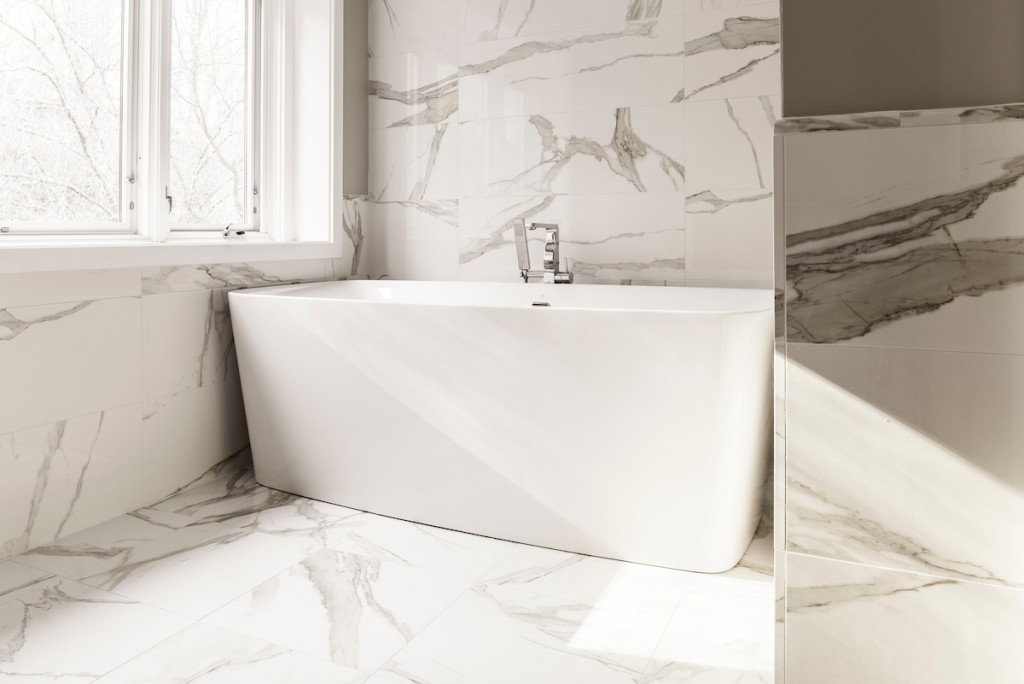
| Accent wall behind a freestanding tub | Works | No direct spray; statement without the wear |
| Primary bath, client commits to maintenance | Works with eyes open | Beautiful if 12–18-month sealing is honored |
The choice belongs to the homeowner; the honest conversation up front decides which camp they’re in.
FAQ
Frequently Asked Questions
What’s the best bathroom tile for an older Chester County home?
For older homes (1988–2008), the most reliable combination is large-format porcelain (12×24+) on the floor, ceramic subway or mid-grade porcelain on shower walls, and mosaic (1×1 or 2×2) on the shower pan for slip rating. Installs reliably over a self-leveled subfloor, lasts 30+ years, stays out of trend territory. Installed cost ~$6–$18/sq ft.
Porcelain vs. ceramic?
Porcelain is denser, fired hotter, and absorbs less than 0.5% water — TCNA treats it as effectively waterproof. Ceramic is softer, absorbs 0.5–7%, and relies on its glazed face. Porcelain wins on floors and high-use shower walls. Ceramic shines on shower walls — especially classic subway — where install labor is lower and the look is timeless.
Is zellige worth the cost?
Yes as an accent, almost never as the dominant tile. $22–$60/sq ft installed and slow to set because every piece is hand-leveled. Beautiful, with depth machine-made tile can’t replicate, but the cost only makes sense on one accent wall, a vanity backsplash, or a powder room. We typically cap zellige at 20–40 sq ft of coverage.
What slip rating should bathroom floor tile have?
DCOF 0.42+ per ANSI A137.1 for level interior wet areas; shower pans and curbless floors 0.60+. Polished porcelain and polished marble are usually too slick to clear 0.42 on a floor. If a spec sheet doesn’t list DCOF, ask — and if it’s not available, pick a different tile.
Marble or natural stone in a shower?
We typically recommend against marble shower pans and against travertine in any wet bathroom area. Both are porous, both reseal every 12–18 months for life, marble etches from anything acidic, travertine absorbs and stains. Natural stone does work on vanity backsplashes, accent walls outside the splash zone, and primary baths where the client understands the maintenance commitment.
Do I need Schluter waterproofing?
Yes. Schluter Kerdi (or an equivalent sheet-membrane) is the modern standard — TCNA method B422 — and what most professional remodelers install on every shower. Adds $800–$1,500 to the shower cost. We treat it as the spec, not an upgrade.
Will my older home’s subfloor or joists be a problem?
Often a manageable line item, not a dealbreaker — but it has to be checked, not assumed. Subfloor flatness corrected with self-leveling ($2–$4/sq ft). Joist deflection matters most for stone (L/720 vs. L/360 for ceramic); if 1990s framing is marginal, sistering a joist runs $400–$1,200. We check before specifying stone.
Sources
- TCNA Handbook — installation methods, substrate flatness specs, method B422 (sheet-membrane shower waterproofing).
- ANSI A137.1 — DCOF slip-resistance standard; the 0.42 threshold.
- Schluter Shower System — manufacturer documentation for Kerdi membrane and drain assembly.
- PA UCC — IRC 2018, governing shower waterproofing and bathroom work.
- PA HIC Verification — Fedor: PA HIC #PA202519.
Next Step
Pick the Right Tile for Your Bathroom
Read how much a bathroom remodel costs in the Philadelphia suburbs so the tile package fits inside a real number, then book a consultation. We’ll walk your bathroom, check the subfloor and joists, and talk through tile that fits your home and budget — no pressure either way.
Or call us directly: 610-431-7150