
Process
How to Prepare for Your Remodeling Consultation in Southeastern PA
The 30-minute checklist that makes your first meeting productive — what to bring, what to think about, and what doesn’t help.
Not ready for a call? Send us a quick question
Last updated: May 2026 · Alex Smearman, Fedor Fabrication
Key Takeaways
- Walk your space for a few days and note what frustrates you — flow, storage, lighting, counter space.
- Bring 10–15 organized inspiration images, MoSCoW-sorted priorities (Must / Should / Could / Won’t this round), and a budget range.
- Knowing your priorities before the meeting is the single most useful thing you can do.
- Prepared consultations produce accurate estimates. Disorganized ones produce guesswork.
Quick Answer
To prepare for a remodeling consultation: sort your wish list into four MoSCoW buckets (Must / Should / Could / Won’t this round), settle on a budget range, and gather 10–15 organized inspiration images. Thirty minutes of prep directly affects how accurate your estimate is and how quickly the project moves — the 2024 U.S. Houzz & Home Study puts the average kitchen-renovation planning phase at 9.6 months, yet most homeowners still feel unprepared for the first meeting. This is the checklist we send every Fedor homeowner; it works equally well with anyone else.
“I want new everything but I’m not sure what” earns a wide range and usually a second meeting that pushes the schedule back by weeks. “Keep the layout, quartz countertops, semi-custom cabinets like at the showroom, budget $60K–$80K” earns a real answer on what’s realistic and where the tradeoffs are.
The Checklist
What to Bring
| What to bring | Why it matters | Example |
|---|---|---|
| List of frustrations with your current space | Functional pain points beat aesthetic complaints — they shape every layout decision. | “Coffee station has no plug” beats “kitchen feels dated.” |
| 10–15 inspiration images, organized | Pinterest or Houzz boards grouped by room or feature show us your taste in 60 seconds. | “Cabinet door styles I like,” “Tile I do NOT want.” |
| MoSCoW priorities: Must / Should / Could / Won’t | Kills the “everything is important” trap and lets us scope honestly to budget. | Must: range vents outside. Could: second sink. Won’t: marble countertops. |
| A budget range (even rough) | Honest ranges let us scope to reality on day one. Refusing a range usually costs a second meeting. | “$40K–$60K, flexing to $75K for the right scope.” |
| Both decision-makers present | Decisions made without a partner get re-litigated at home, slowing everything. | Spouse + you at the table for the in-home visit. |
| Timeline and hard deadlines | Holiday, baby, move-in date — these change the cabinet brand we recommend. | “Finished by Thanksgiving” → Tribeca quick-ship, not custom. |
| 3–5 of your own questions | Your scope-specific concerns. We expect them. We respect homeowners who arrive curious. | “What about a beverage fridge?” “Can the island fit a prep sink?” |
Notice what frustrates you (not what it looks like)
Spend a few days noticing what frustrates you — not what the space looks like, how it works. That’s the most valuable information you can hand a contractor.
- Flow. Do you walk back and forth across the kitchen for basic tasks? Reach over someone to get to the sink?
- Counter space. Run out when cooking a real meal? Prep close to where you need it?
- Storage. Enough? In the right place? Everyday dishes on the opposite side of the dishwasher?
- Lighting. Dark over the counter where you chop? Casting a shadow on your own workspace?
- How you live. Where do groceries land? Where do kids do homework? Where does everyone stand at a party?
- Bathroom-specific: two people fighting over one sink in the morning? Shower too small or dated? Tub collecting dust? Wasted space — tight doorway, vanity in the wrong spot, dead corners?
That picture of how you actually live — not a Pinterest photo — is what helps us design it.
Inspiration images — organized
Organize 10–15 images by what you actually like about each — layout, color, cabinet style, countertop material. A board with 12 images where you can point and say “I love the countertops here but hate the cabinet color” tells us more than an hour of conversation. Photos of things you don’t like are just as useful. If you have time, walk a showroom first: 30 minutes at Weinstein Supply in West Chester or Ferguson in King of Prussia calibrates your taste against real prices better than two hours on Google. Tile at Avalon Flooring or The Tile Shop; appliances at Gerhard’s in Malvern.
MoSCoW priorities: the framework we use
This is the single most useful thing you can bring. Sort what you want into four buckets:
- Must have — if these aren’t in the final project, it didn’t work.
- Should have — you really want these, but the project could survive without one.
- Could have — nice if budget allows, easy to cut if it doesn’t.
- Won’t have (this round) — explicitly out of scope. The bucket almost everyone skips — and the one that saves the most money. Deciding up front that the gas line stays put or the exterior wall doesn’t move keeps a $60K project from quietly becoming a $90K one.
| Bucket | Kitchen example | Bathroom example |
|---|---|---|
| Must | More storage, better lighting, layout that works for how we cook | Walk-in shower replacing the jacuzzi tub, double vanity |
| Should | Quartz countertops, new flooring throughout | Floor-to-ceiling tile, better ventilation and lighting |
| Could | Pot filler, under-cabinet lighting, window over the sink | Heated floors, frameless glass, freestanding soaking tub |
| Won’t | Moving the gas line, bumping out the exterior wall | Relocating the toilet, moving plumbing to the opposite wall |
A budget range — even rough
You might worry that sharing your budget means we’ll spend all of it. That’s not how it works with a good contractor. If your budget is $40K and you’re describing a $100K kitchen, we’d rather say so in the first meeting than after three weeks of waiting for a shocking estimate. A range is fine: “$40K–$60K,” “under $50K.” What doesn’t help is “I don’t have a budget” — everyone has one. If you’re not sure what’s realistic, read our 2026 kitchen cost guide or bathroom cost guide first — both built from real Fedor projects in Chester County and Delaware County, not national averages from a website in California.
Six questions worth asking
Write them down — you’ll forget half once the conversation starts. The six that give the most signal:
- How do you handle change orders?
- How do you handle permits?
- What does your payment schedule look like?
- Can I talk to clients from recent projects?
- Who will be on the jobsite every day?
- What’s your typical timeline from contract to completion?
The answers to these tell you more about a contractor than their website ever will. Full list in how to choose a remodeling contractor.
Avoid These
Three Mistakes That Make a Consultation Harder
Don’t get fixated on one photo. One Instagram kitchen doesn’t define a scope. Bring multiple images so we can identify patterns. Don’t expect a price on the spot. A responsible contractor needs to assess the space and build a detailed proposal. A same-day price is a guess or a red flag — if someone quotes a number before looking at your electrical panel or plumbing access, ask yourself how accurate it can possibly be. Don’t sign anything at the first meeting. Any contractor pressuring you to sign on day one is telling you something about the rest of the project. At Fedor we never ask for a same-day commitment.
The Process
What Happens at a Fedor Consultation
| Phase | Duration | What we do |
|---|---|---|
| Intake call | 15–20 min | Confirm scope and fit, schedule the in-home, send the MoSCoW worksheet. |
| Pre-visit prep | ~10 min on your end | Walk the space, snap quick photos of pain points, fill out the worksheet. |
| In-home consultation | 60–90 min | Walk every space, measure, talk layout options and tier-by-tier budget ranges. |
| Showroom guidance | Your timeline | Send you to Gerhard’s, Weinstein Supply, or Avalon Flooring with our spec notes. |
| Estimate + selections | 1–3 weeks | Build the fixed-price proposal, finalize material selections. |
| Contract signing | 30 min | Walk the contract line by line — scope, allowances, milestones, schedule. |
If you book with us, you don’t build the list alone. Once your in-home is scheduled, we send a short MoSCoW priorities worksheet. Ten minutes on your end, and Alex walks in already knowing your priorities, so the visit is spent solving rather than discovering. The full path lives on our process page, and the consultation itself is detailed in what to expect at your first consultation.
Questions
Frequently Asked Questions
How long does a remodeling consultation take?
An in-home kitchen consultation runs 60–90 minutes, a small bathroom about 30, a master bathroom 45–60. Plan for the longer end — the questions that surface in the last 15 minutes are usually the most important. Alex runs every consultation personally. A prepared MoSCoW list keeps the visit focused on solving rather than discovering.
Are remodeling consultations free?
Ours are. Some contractors charge $200–$500+ in the Philadelphia suburbs, so ask upfront. A free consultation should still be a real working session: come with MoSCoW priorities and a budget range and you’ll leave with a genuine read on what’s realistic, whether or not you hire us.
Do I need to have measurements ready?
No — we measure during the home visit. We’re looking beyond dimensions: electrical panel capacity, plumbing access, structural indicators, and the quirks of older homes across Chester County, Delaware County, and the Main Line. Your 30 minutes is better spent on MoSCoW priorities and a budget range than on a tape measure.
Should I get multiple consultations?
Yes — meet with 2–3 contractors and compare. Bring the same MoSCoW priorities and budget range to each; consistent inputs make estimates genuinely comparable. Our guide on how to compare remodeling estimates walks the method. We’ll tell you honestly if another contractor is the better fit.
How soon before construction should I book?
As soon as you’re seriously considering it — even 9–12 months out. The Houzz 2024 study puts the average planning phase at 9.6 months. Realistic calendar from first call to a finished space: 4–7 months for a kitchen Full Remodel, 3–5 months for a bathroom Full Remodel. Booking early gives you room to refine selections, lock cabinets (Tribeca 2 weeks, Shiloh 6 weeks, Great Northern 8–10 weeks), and pick a construction window that fits your life.
Can I have a remodeling consultation by video call?
For initial scoping, yes — a 15–20 minute video intake confirms fit before we send anyone to your house. The estimate visit must be in-home: we measure, look behind doors and under sinks, check structural questions, and catch things cameras miss. We’ve never produced a meaningful fixed-price estimate from a video tour alone.
Sources
- 2024 U.S. Houzz & Home Study — renovation trends and homeowner planning timelines, including the 9.6-month average planning phase.
- PA HIC Search — verify any PA contractor’s registration before signing.
- NKBA — industry benchmarks for kitchen and bath remodeling costs and standards.
Free Downloads
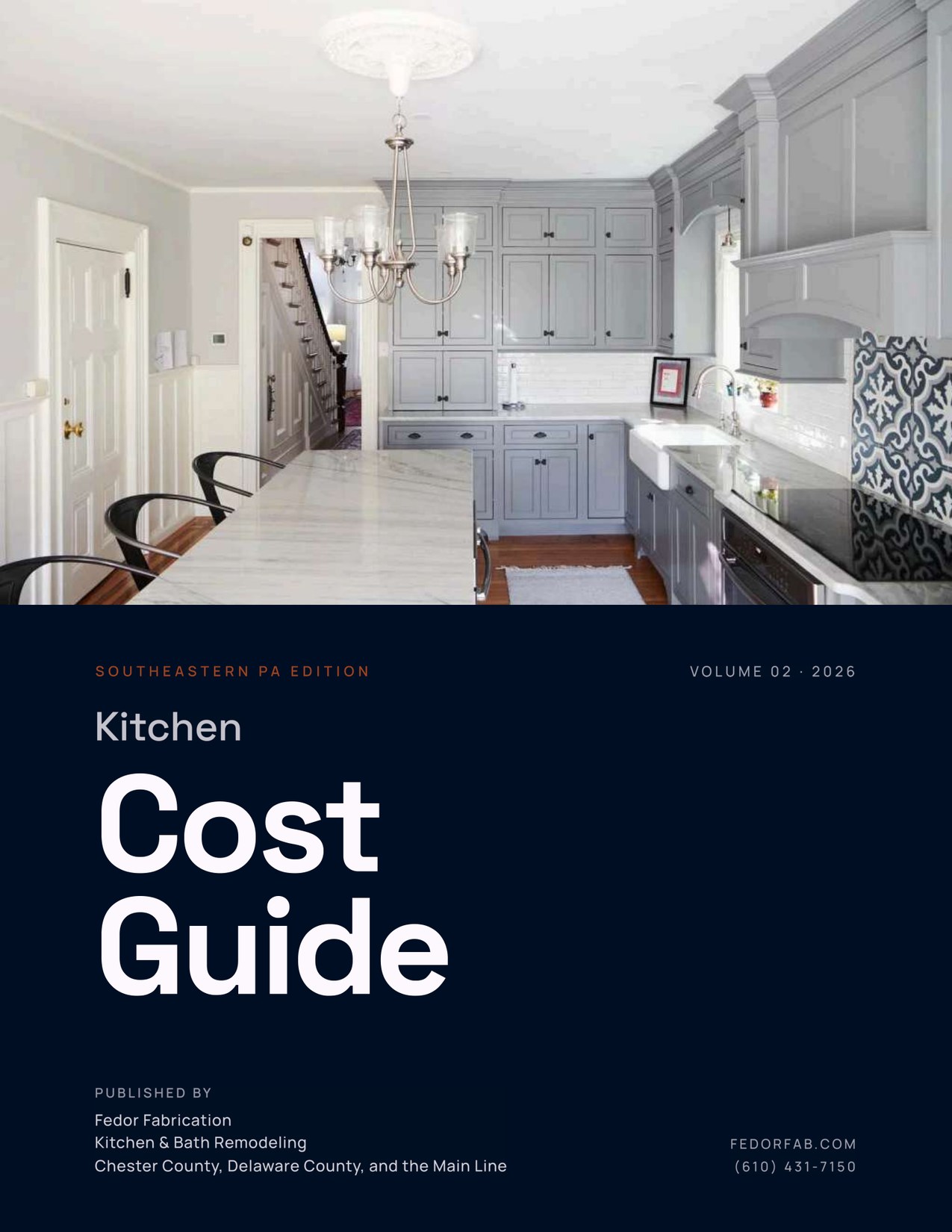
2026 Southeastern PA Cost Guides
Real 2026 pricing for kitchen and bathroom remodels in Chester County, Delaware County, and the Main Line.
Kitchen Cost Guide
All 4 kitchen tiers, $30K–$190K+. Line-item breakdowns from completed Fedor projects.

Bathroom Cost Guide
All 3 bathroom tiers, $25K–$90K+. Tier-by-tier scope from real Fedor bathroom remodels.
Free PDF · No spam · Unsubscribe anytime
Ready to Meet?
Book a Free Discovery Call
A 15-minute call to see if Fedor is a good fit. We’ll talk scope, answer your questions, and schedule the in-home visit from there. No charge. No obligation. If we’re not the right fit, we’ll tell you — and point you toward someone who is.
Or call us directly: 610-431-7150