
Design
Best Walk-In Shower Designs in Southeastern PA
Seven walk-in shower designs that hold up in real Chester County, Delaware County, and the Main Line bathrooms — with honest cost and upkeep.
Not ready for a call? Send us a quick question
Last updated: May 2026 · Alex Smearman, Fedor Fabrication
Key Takeaways
- Seven walk-in shower designs hold up across our market in 2026: frameless curbless ($18K–$30K+), full-height tile + feature wall ($14K–$25K+), bench + niche ($12K–$22K), dual-showerhead ($20K–$30K+), wet-room ($22K–$35K+), industrial black-frame ($16K–$25K+), spa-minimal ($10K–$18K).
- Curbless entry is the highest-impact aging-in-place feature — adds $2,500–$5,000 over a curbed shower.
- Frameless glass with full-height neutral porcelain ages best. Framed sliding doors with a decorative accent band age worst.
- We waterproof with Schluter Kerdi/Kerdi-Line. Fixtures through Weinstein Supply and Ferguson; tile through Avalon Flooring and The Tile Shop.
- A “$6,000 luxury shower” in an ad is an acrylic surround — a different product. Real tile-and-glass walk-ins start meaningfully higher.
Cost runs from roughly $8,000 inside a full bath remodel to $30,000+ for a premium curbless build. This is a design article. If pricing is your first question, read How Much Does a Walk-In Shower Conversion Cost? first. This guide is for the homeowner already past pricing — you want to see which designs actually get built here, and which look dated in five years. Most “30 walk-in shower ideas” listicles refuse to say which designs age poorly because they’re written by editors, not contractors. We’ve removed too many framed sliding-door enclosures and beige-tile-with-a-decorative-stripe showers to pretend they’re equivalent.
Quick Reference
Terms Used Throughout
- Curbless / zero-threshold: no lip at the entry; floor runs flat into a recessed, sloped shower floor.
- Frameless glass: 3/8″ or 1/2″ tempered glass, no perimeter frame.
- Linear vs. center drain: a linear drain along one wall lets the floor slope in one plane (required for large-format tile and curbless). A center drain needs four-way pitch, which forces small tile.
- Niche: recessed waterproofed shelf. Bench: built-in seat. Wet room: single waterproofed zone holding both shower and freestanding tub.
- Schluter Kerdi / Ditra: bonded waterproofing system we install on every shower.
“When a homeowner shows us 30 inspiration photos and asks which one ages well, we can answer in five seconds — we’ve torn out the styles that didn’t.”
At a Glance
The Seven Designs at a Glance
| Design | What It Is | Cost | Maintenance | Best For |
|---|---|---|---|---|
| 1. Frameless curbless | Frameless glass, zero-threshold, linear drain | $18K–$30K+ | Squeegee after every use; spots show | Stay-15+-years owners, aging-in-place planners |
| 2. Full-height tile + feature wall | Floor-to-ceiling tile, one statement wall | $14K–$25K+ | Feature tile is the most permanent decision | Owners who want one focal point |
| 3. Bench + niche | Built-in seat + tiered niche, set to user height | $12K–$22K | Solid-stone bench top avoids grout failure | Tall users, aging-in-place, long showers |
| 4. Dual-showerhead suite | Two valves/heads, large footprint | $20K–$30K+ | Two valve cartridges to maintain | Couples who genuinely shower together |
| 5. Wet-room | Shower + freestanding tub behind one glass panel | $22K–$35K+ | Whole zone stays wet longer; towel floor | Large master baths, spa-minded owners |
| 6. Industrial black-frame | Matte-black grid metal frame on glass | $16K–$25K+ | Black hardware shows spots; frame collects scum | Main Line transitional homes |
| 7. Spa-minimal | Single fixed panel, restrained palette, small footprint | $10K–$18K | Lives or dies on tile selection | Hall baths, townhomes, empty-nesters |
Spa-minimal and bench + niche fit inside a Bath Refresh ($25K–$40K) or Full Bath Remodel ($35K–$65K). Full-height tile, black-frame, curbless, and dual-shower land in Full Bath to Master Bath ($35K–$90K+). Wet-rooms top of Master Bath. Aging-in-place add-ons $3K–$8K at any tier.
Per Style
Design Notes (Per Style)
1. Frameless curbless. Most-requested in our market. Reads modern in a 1985 Downingtown colonial or a 2023 build, and the only design where the visual upgrade and the aging-in-place upgrade are the same decision. What we install: 3/8″ tempered low-iron glass; Schluter Kerdi-Line or Infinity Drain; Schluter Kerdi membrane on walls; Kohler (Real Rain, Purist), Delta, or Brizo (Litze) fixtures by tier; 12×24 large-format porcelain walls, small-format porcelain floor. Tradeoffs: squeegee after every shower; slightly larger footprint; glass takes 2–3 weeks from tile-finished to installed.
2. Full-height tile with a feature wall. Tile floor-to-ceiling on every wall; one wall — usually behind the showerhead — gets a different tile as the feature (vertical-stack subway, large-format porcelain slab, marble waterfall, or handmade zellige). Done well, makes a $55,000 master bath read like an $80,000 one. Honest position: marble feature walls etch. Shampoos with citric acid and acidic cleaners leave dull marks — sealed marble still etches. If you love marble, accept etching as patina. If you want the look without the worry, large-format marble-look porcelain is dramatically more durable.
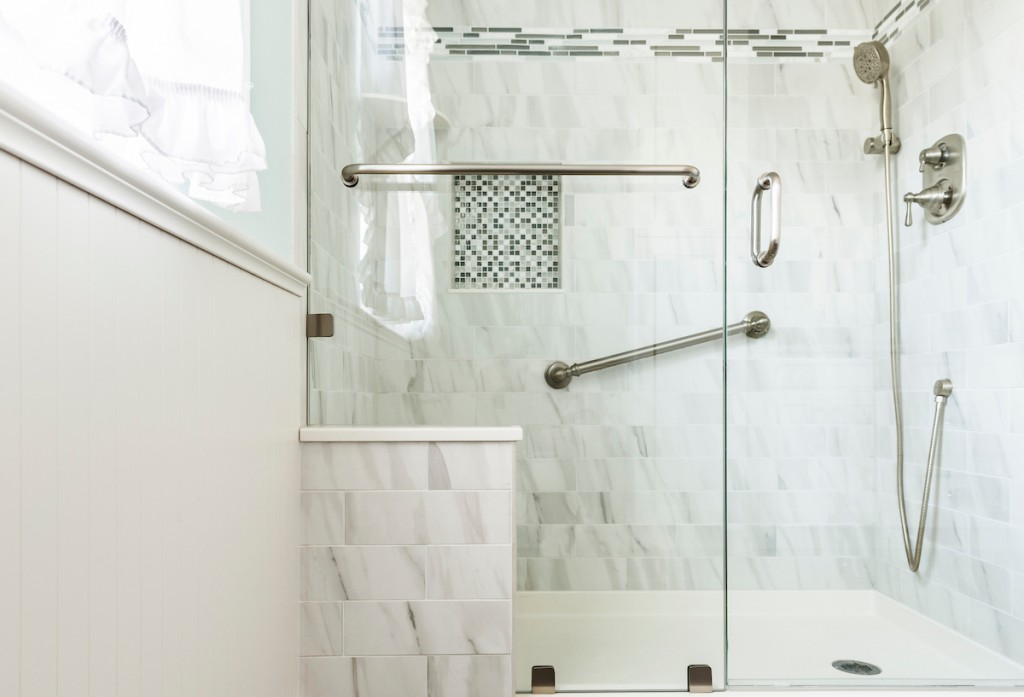
3. Bench + niche for tall users. Built-in bench (12″–16″ deep, 18″–22″ tall) plus a vertical multi-tier niche at the homeowner’s eye level — which means we ask their height before we frame it. What we build: 2×4-framed bench with plywood substrate, then mortar bed + tile OR pre-fab Schluter Kerdi-Bench; pre-fab Kerdi-Board or Wedi niches; a single slab of stone on the bench top (often a near-free fabricator remnant) instead of tile. Always specify grab-bar blocking on every primary bath. Tradeoff: a tiled-top bench is a maintenance liability — the grout line at the front edge is the single most common grout-failure point in the whole shower. Solid stone eliminates it.
4. Dual-showerhead suite. Two showerheads on opposite or adjacent walls, with two valves so each user controls their own temperature. Footprint: 60″x72″ minimum, 72″x80″ preferred. What we install: two thermostatic valves (cartridge holds set temperature even if a toilet flushes) from Kohler, Delta, or Brizo. Non-thermostatic on a dual setup means one user’s kitchen-sink draw can scald the other. Honest position: most dual-shower requests are aspirational. We’ll talk you out of it if it doesn’t fit your life — that’s $5,000–$8,000 saved.
5. Wet-room. Single waterproofed zone containing both the walk-in shower and a freestanding tub, separated by one fixed glass panel. Trending hard in 2025–2026 master baths. Needs roughly 10’x8′ minimum. Honest position: the freestanding tub is beautiful but hard to clean behind; the floor stays wet longer (expect to towel after a shower); and if you don’t take baths, it’s expensive theater. Aging-in-place planners should know: climbing into a freestanding tub is harder, not easier, than a curbed soaker.
6. Industrial black-frame. Glass enclosure with a matte-black metal frame in a grid or windowpane pattern — also called “industrial,” “factory-window,” or “barn-door.” Trending hard in Main Line and Chester County master baths since 2023, typically paired with concrete-look or marble-look porcelain. The frame itself is a $1,500–$3,500 premium over standard frameless. Honest position: highest trend-exposure design in the guide. We don’t know yet whether this look ages like Carrara marble or like 1992 brass. Black hardware shows spots; frame intersections collect soap scum — more cleaning than frameless.
7. Small-footprint spa-minimal. 36″x60″ or 40″x54″ walk-in in a hall bath or smaller primary, designed to feel premium without the master-bath footprint. Single fixed glass panel (no door — opening is wide enough), full-height large-format porcelain, one horizontal niche, no bench, no curbless. The whole design is restraint. What we spec: a single large-format porcelain (24×48, or 30×60) in a neutral — bone, warm grey, soft white; 36″–48″ frameless 3/8″ fixed panel; handheld-plus-showerhead combo on a slide bar; one horizontal niche at chest height with a single-stone shelf. Tradeoff: lives or dies on tile selection. A $4 builder-grade porcelain looks cheap; a $14 large-format porcelain looks intentional.
Most Common Design Mistakes
| Mistake | Why It Fails | What We Recommend Instead |
|---|---|---|
| Trendy-now tile (decorative bands, busy mosaic stripes, gloss coordinates) | Looks dated by 2032; most permanent decision in the room | One timeless material in a non-trendy color, one statement, not five |
| Curbed shower in a primary bath where the owner plans to age in place | The retrofit-later math never works | Curbless during the remodel |
| Frameless glass on a 7’0″ ceiling | Reads compressed and cheap | A more substantial framed or industrial black-frame enclosure carries visual weight on lower ceilings |
| Marble feature wall sold without explaining etching | Owner is shocked the first time shampoo dulls it | Accept etching as patina, or use large-format marble-look porcelain |
| Skipping grab-bar blocking | $40 of lumber now becomes a $2,000 wall-opening retrofit later | Always specify blocking behind shower walls and around the toilet, even for a healthy 45-year-old |
Straight Talk
What We Tell Our Clients
When a homeowner shows up with a phone full of saved photos, we sort them into “ages well” and “ages poorly” out loud, with reasons. Frameless glass and full-height neutral porcelain are the safest design money you’ll spend. Accent-mosaic stripes and framed sliding doors are the opposite — we’ve removed a lot of those, usually less than fifteen years old, usually because the homeowner was embarrassed. If you have the budget and you’re staying, do curbless.
We also talk people out of money regularly. Most dual-shower requests don’t survive “do you actually shower at the same time on weekday mornings?” Most wet-room requests don’t survive “how often do you actually take a bath?” Saying no to $5,000–$8,000 of scope you won’t use isn’t leaving money on the table — it’s the reason you can trust the yes.
FAQ
Frequently Asked Questions
What’s the most popular walk-in shower design in 2026?
The frameless glass curbless walk-in — 3/8″ or 1/2″ tempered glass, linear drain, full-height 12×24 porcelain, small-format porcelain floor. Runs $18,000–$30,000+ at the Master Bath level. Industrial black-frame is rising fast in Main Line transitional and stone-colonial homes, but hasn’t been around long enough for us to know how it ages.
What walk-in shower design ages best?
Frameless glass with full-height neutral porcelain and a single restrained accent — vertical-stack subway, large-format slab, or zellige. We’ve never torn one out and wished we’d done something else. Worst-aging: framed sliding-door enclosures with a decorative tile band, busy mosaic accents, and coordinate-tile sets where floor and wall match by design.
Is a curbless shower worth the extra cost?
Yes in two cases: you’re aging in place and want it installed once instead of retrofitted later, or you want the cleanest modern look available. Curbless adds $2,500–$5,000 over a curbed shower at the same finish level. If neither matters, a curbed shower is functionally identical and saves the money.
Can you build these designs in an older Chester County or Delaware County home?
Yes, but joist direction, ceiling height, and plumbing layout matter. On a 1990s colonial with a 7’8″ ceiling, all seven designs are buildable. On a 1980s Delaware County townhome with a 7’0″ ceiling and joists running the wrong way for a curbless drain, we’ll steer you to a curbed solution. Usually a five-minute consultation check.
What waterproofing system do you use?
The Schluter system — Kerdi membrane bonded to the shower walls, Kerdi-Drain or linear Kerdi-Line at the drain, Ditra-Heat under heated floors outside the shower. Bonded-membrane system, the same approach every reputable tile setter locally uses, what makes a curbless single-plane slope reliably watertight.
Which fixture brand should I pick?
Kohler (Real Rain, Awaken, Purist), Delta (thermostatic valves at a sensible price), Brizo (Litze) for higher-end. We avoid big-box private-label fixtures for finished work — valve cartridges tend to fail at 8–12 years and replacements aren’t always available. We source through Weinstein Supply (West Chester, Kennett Square) and Ferguson (King of Prussia).
Does a rain showerhead actually have good pressure?
Honestly, not the way most people picture it. A ceiling-mounted rain head delivers a soft, gravity-fed drop, not a forceful spray, and Pennsylvania fixtures are federally capped at 2.5 GPM. We almost always pair a rain head with a separate wall or handheld head on its own valve — which is why dual-valve designs cost more.
Sources
- Schluter-Systems Shower System — Kerdi/Kerdi-Line/Ditra-Heat specifications.
- NKBA Planning Guidelines — shower footprint minimums, bench dimensions, niche placement.
- NAHB Aging-in-Place / CAPS — curbless showers, grab-bar blocking, universal design.
- PA HIC Verification — Fedor: PA HIC #PA202519.
- Houzz Bathroom Trends.
Next Step
Which Design Is Right for Your Bathroom?
Book a free consultation and we’ll walk your space and give you a straight design recommendation, range, and timeline. No pressure, no same-day signing.
Or call us directly: 610-431-7150